Research note
CNN or LSTM: which should read a sensor pen?
CNN, LSTM or both? Why Vahini reads pen motion with a CNN-BiLSTM, and when a GRU, Transformer or autoencoder would fit better.
Revised 8 October 2026 · Measured results from the imu2text benchmarks, with sources below
The question
CNN, LSTM or both? Why Vahini reads pen motion with a CNN-BiLSTM, and when a GRU, Transformer or autoencoder would fit better.
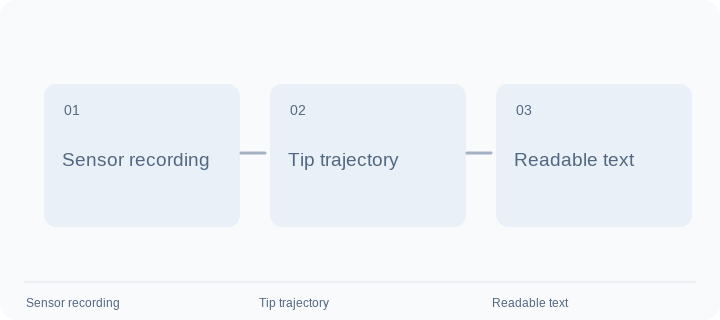
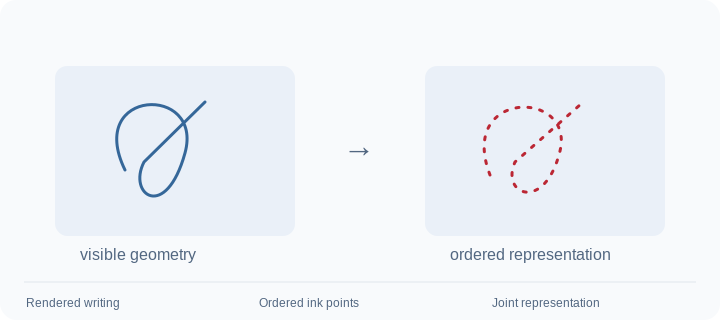
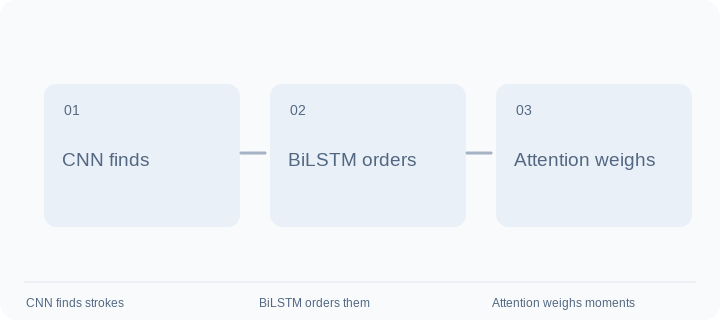
A sensor pen does not see ink. It records 13 numbers 100 times a second from two accelerometers, a gyroscope, a magnetometer and a force sensor, and one letter is about a second of that. A model has two jobs: find short stroke shapes, then put them in order. A CNN is good at the first and a BiLSTM at the second, which is why the pair is the usual design on the Fraunhofer OnHW datasets. Background: Fraunhofer IIS: the OnHW datasets; imu2text: benchmarks and method; Vahini Playground; Vahini Playground: how CNN, LSTM and hybrid networks read handwriting.
On the official OnHW-chars test (52 classes, writers the model never saw, seed 0) our tuned CNN-BiLSTM reads 72.46% of letters; the CNN-BiLSTM published by Ott et al. reads 68.06%. Five runs of the same design voting together read 74.46%. On a small left-handed set whose split shares writers, the plain designs rank CNN-BiLSTM 64.8%, BiLSTM 56.2%, CNN 48.7% and LSTM 43.8%.
Bigger did not help. A two-layer BiLSTM scored 99.2% on its own training letters and 70.4% on new people: it memorised. GRUs, Transformers, autoencoders and VAEs have not been measured on this data yet, and the Vahini Playground lists them as open experiments.
Each part has one job. A CNN slides a small filter along the signal and fires wherever a short stroke appears, early or late. An LSTM reads the signal one moment at a time and carries a memory, so a loop at the start of a letter still counts at the end; a BiLSTM adds a second LSTM reading backwards. Attention then scores every moment and lets the deciding ones, a crossbar or a loop, count most. Adding attention took new people from 70.0% to 70.9%. The Vahini Playground animates each of these steps.
Worked example
Pick the design from the data you have
Few labelled recordings and short signals: start with a CNN-BiLSTM. Many recordings without answers: train an autoencoder on them first, then teach it letters. A rare group, such as left-handed writers (59.47% against 74.46% for right-handed writers): make extra recordings with a VAE or GAN, or augment. A small chip inside the pen: try a CNN or a CNN-GRU. Much more data than OnHW has: try a Transformer.
How to evaluate it
- 01
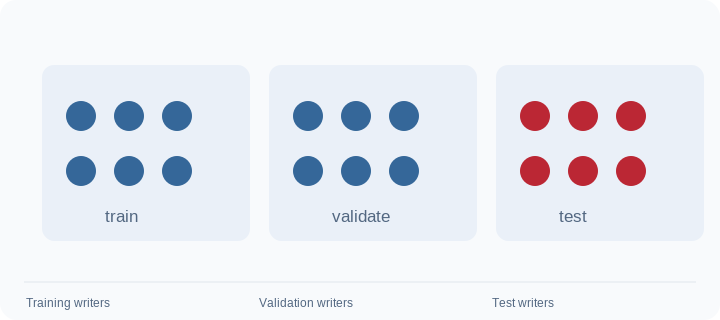
Hold out whole writers for testing, and fit normalisation only on training writers.
- 02
Compare designs on the same split, seed and number of training rounds, and report the spread over several seeds.
- 03
Watch the gap between training and test accuracy. A design that memorises looks best on the data it trained on.
What remains open
Many small and capital letters are the same movement at a different size, and the pen measures motion, not position. On OnHW-chars 43.1% of the tuned model's errors are this mix-up, and no choice of design removes it alone.
Sources & scope
- Fraunhofer IIS: the OnHW datasets
The sensor-pen recordings behind these numbers, published for non-commercial research.
- imu2text: benchmarks and method
Every number in this note with its split, seed and command. The published 68.06% is Ott et al., ACM MM 2022, Table 3.
- Vahini Playground
Pick a letter, clean the signal and press Recognize to see what the model reads, plus the open experiments.
- Vahini Playground: how CNN, LSTM and hybrid networks read handwriting
Five short animations: a neural network learning, a CNN filter sliding along the pen signal, an LSTM and a BiLSTM, attention, and the CNN-BiLSTM used here.
Related Vahini work: Project Akshara · Specifications and measurement status.